Services
Psychotherapy
A specialist intervention for lasting change — for thought patterns, emotional difficulties, relationships or mental health conditions. Medium- to long-term, coordinated with the psychiatrist where needed.
What psychotherapy is
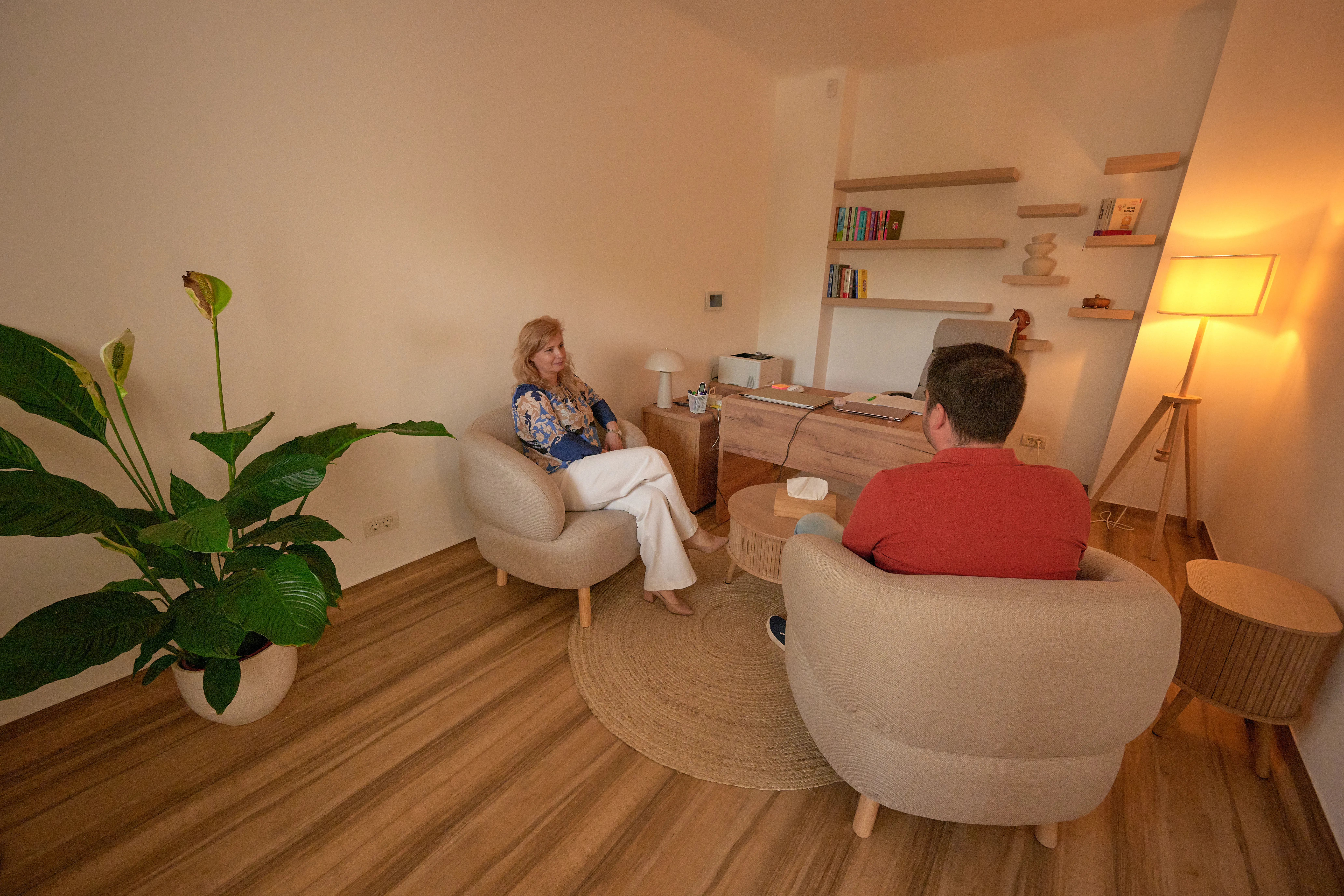
Psychotherapy is a specialist intervention for lasting change in how you think, feel and relate. It is carried out by psychotherapists with specific training, within a stable therapeutic relationship, over the course of several months or years.
Unlike counselling (which works with concrete situations in the present), psychotherapy works with deep patterns — automatic ways of reacting, beliefs about yourself and the world, persistent emotional difficulties. Unlike medication (which targets the biological component of symptoms), psychotherapy targets the psychological, relational and underlying component.
The two approaches are not mutually exclusive — for many conditions, the combination is more effective than either alone.
Not sure whether you need psychotherapy or counselling? See the difference →
Who psychotherapy is for
Psychotherapy is indicated for a broad range of situations:
Mental health conditions:
- depression — particularly recurrent depression or depression underlain by lasting patterns
- anxiety disorders — generalised anxiety, panic attacks, phobias, obsessive-compulsive disorder
- mood disorders
- personality disorders — psychotherapy is the treatment of choice
- trauma-related disorders
Patterns that repeat:
- relationships that fail in the same way
- recurring conflicts with colleagues, managers or family
- decisions you regret, repeated over the years
- persistent difficulties with intense emotions
- an unstable or deeply negative self-image
Suffering that does not resolve with one-off interventions:
- a constant sense that “I am not myself”
- a persistent inner emptiness
- difficulty forming close relationships
- marked fear of abandonment, or, conversely, of closeness
- a sense that life is meaningless
Support during acute moments (exceptional situations):
- suicidal intent — psychotherapy can be part of the care plan, in close coordination with the psychiatrist
- complicated or prolonged bereavement
- deep existential crises
- acute situations of major conflict
Supporting the work of bereavement — psychotherapy can be a valuable framework for processing important losses, especially when grief is prolonged or complicated.
Types of psychotherapy
There are several modalities of psychotherapy, each with its own principles and methods. In brief, the main directions:
Cognitive-behavioural therapy (CBT) — focused on identifying and changing the patterns of thought and behaviour that maintain suffering. Structured, with clear goals, of medium duration. Effective for anxiety disorders, depression, OCD and other specific conditions.
Psychoanalytic psychotherapy — a deeper exploration of the unconscious, of personal history and of patterns formed in childhood. Longer in duration, less structured, focused on self-understanding.
Analytical psychotherapy — exploring the unconscious through symbols, dreams and the process of individuation.
Transactional analysis — explores the ego states (Parent, Adult, Child) and the relational patterns that arise from their interaction.
Couple and family therapy — focused on the relational system, not just on the individual. Indicated for relationship difficulties, family conflicts and dysfunctional communication.
Other approaches — there are many other modalities (psychodrama, systemic therapy, Adlerian therapy, Ericksonian hypnosis and so on). At Acord Med, our therapists work in several modalities; we will recommend the approach that fits your situation best.
What psychotherapy is like
The first session lasts approximately 60 minutes and is an introductory meeting: a conversation about what brings you in, your personal and symptom history, clarification of goals — what you would like to change or understand — and agreement on the framework of work (frequency, estimated duration, the chosen modality).
Subsequent sessions are usually weekly, lasting 45–50 minutes, and take place within a stable frame — the same time, the same day, the same place. This frame is part of the intervention: stability provides the safety needed to work on difficult material. Every few months, the therapist and patient discuss where the process is, what has changed, and what is still to be worked on.
Total duration varies: for specific goals with CBT, 4–12 months; for deeper changes (analytical psychotherapy, personality disorders), 1–3 years or more.
Coordination with the psychiatrist
For conditions that benefit from a combined approach (medication and psychotherapy), Acord Med offers direct coordination between specialists.
In practice, this means:
- the psychiatrist and the psychotherapist communicate about the patient’s progress (with their consent)
- the treatment plan is integrated — with no contradictory messages
- adjustments to treatment are discussed within the team
- the patient does not have to act as a “messenger” between specialists
This coordination is one of the essential components of how we work.
Cost and CNAS
CNAS coverage — certain psychotherapy services can be covered by Acord Med’s contract with the National Health Insurance Fund, on the basis of a referral. We can advise at the time of booking on the available options for each type of psychotherapy.
Paid — current rates for psychotherapy are on the Pricing page. For couple or family therapy, the rate may differ.
Specialists who provide psychotherapy

Psih. Magdalena Ioan
Senior Clinical Psychologist

Psih. Oana-Marina Ciocan
Senior Clinical Psychologist

Psih. Alexandra Gujan
Senior Clinical Psychologist

Psih. Ioana Daniela Neacșu
Senior Clinical Psychologist

Dr. Daniela Cojocaru
Senior Consultant Psychiatrist · Founder of Acord Med

Dr. Dan Cojocaru
Senior Consultant Psychiatrist
To see the full team, visit the Team page.
Frequently asked